What is APQP? Definition
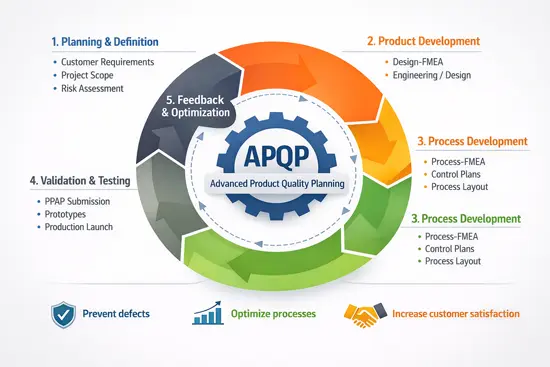
The APQP Quality Planning (Advanced Product Quality Planning) is one of the key methods in modern quality management – especially in the automotive industry, but increasingly also in other sectors. The goal of APQP is to ensure already during the development and planning phase that products and processes meet customer requirements and can be smoothly transferred into series production. Companies that consistently apply APQP reduce defect costs, avoid late changes, and sustainably increase customer satisfaction.
APQP stands for "Advanced Product Quality Planning" and describes a structured planning process to ensure product quality. The method was developed by the Automotive Industry Action Group to establish standardized quality requirements in the automotive industry. Today, APQP is closely linked to standards such as IATF 16949 and is considered a best practice for quality planning.
The core idea is to identify risks at an early stage, clearly define requirements, and plan all relevant processes in such a way that a product is "right the first time" – instead of correcting errors later at high cost.
The 5 Phases of APQP Quality Planning
The APQP methodology is divided into five clearly defined phases that accompany the entire product development process:
1. Planning and Definition of the Program
In this phase, customer requirements are analyzed and project goals are defined. This includes specifications, feasibility analyses, and initial risk assessments. Proper planning forms the foundation for all subsequent steps.
Typical contents:
- Understanding customer requirements
- Defining the project scope
- Initiating risk analyses
2. Product Design and Development
In this phase, the product is developed in detail. Design, material selection, and functional requirements are the main focus. An important tool is Design FMEA (Failure Modes and Effects Analysis), which helps identify potential failures early.
3. Process Design and Development
This phase focuses on planning the production process. The goal is to develop stable and capable processes that reliably produce the desired product.
Typical activities:
- Creating process flow diagrams
- Conducting Process FMEA
- Defining control plans
4. Product and Process Validation
At this stage, product and process performance are tested under real conditions. This includes initial sampling, prototype testing, and production trials. A key element is the PPAP approval (Production Part Approval Process), which confirms that all requirements are met.
5. Feedback, Assessment, and Corrective Actions
After production start, data is collected and analyzed. Deviations are evaluated, and improvement measures are implemented. This continuous improvement process ensures long-term process stability and product quality.
Why is APQP so important?
The importance of APQP Quality Planning lies primarily in its preventive approach. Instead of detecting errors during production or at the customer, potential issues are identified and avoided in advance. Companies benefit in several ways:
- Reduction of scrap and rework
- Lower quality costs
- Faster time-to-market
- Higher customer satisfaction
Especially in the context of complex supply chains and increasing quality requirements, APQP is a decisive competitive advantage.
Key Methods and Tools in APQP
APQP is not a standalone tool but a framework that integrates various quality methods:
- FMEA (Failure Modes and Effects Analysis) for risk identification
- Control Plan for managing production processes
- MSA (Measurement System Analysis) to ensure reliable measurement systems
- SPC (Statistical Process Control) for process monitoring
These tools interact with each other and ensure that quality is systematically planned and controlled.
APQP and its Connection to IATF 16949
The APQP Quality Planning is closely linked to IATF 16949, the globally recognized standard for quality management in the automotive industry. Companies certified according to this standard must integrate APQP into their processes. This means in practice:
- Structured project planning
- Documented risk analyses
- Clear evidence of product and process approvals
APQP is therefore not just a recommendation, but in many cases a mandatory method.
Typical Challenges in Implementation
Despite its many advantages, companies often struggle to implement APQP consistently. Common issues include:
- Unclear responsibilities
- Incomplete documentation
- Time pressure in projects
- Lack of understanding of the methodology
A common mistake is to implement APQP only "formally" without embracing the actual idea of preventive quality assurance.
Best Practices for a Successful APQP Implementation
For APQP to achieve its full potential, companies should consider several success factors:
- Early involvement of all departments (development, production, quality)
- Clear communication of requirements
- Consistent use of FMEA and control plans
- Regular reviews and milestone checks
A strong quality culture is crucial – APQP is not a one-time project, but a continuous process.
PeRoBa Quality Management from Munich – Custom Quality Management and APQP Consulting

PeRoBa GmbH Munich
APQP Consulting
Consulting, Implementation, Audits, and QM Tools from a Single Source
APQP (Advanced Product Quality Planning) is far more than a formal process – it is a strategic tool to ensure quality and efficiency. Companies that apply APQP consistently benefit from stable processes, lower costs, and more satisfied customers.
In a time when mistakes are increasingly costly and market requirements ever more complex, APQP is not a "nice-to-have" but a crucial success factor.
PeRoBa GmbH Munich is a service provider with many years of experience in quality management, especially in the automotive and mechanical engineering sectors. We assist with all key standards (ISO 9001, VDA 6.3, IATF 16949, ...) on the path to certification or recertification. We show you how to build your quality management system with APQP in a future-proof and effective way.
We look forward to hearing from you. The best way to reach us is by phone at
+49 8106 / 230 89 92
(additional
contact options)
Quality Management – ISO 9001, VDA 6.3 and IATF 16949 Consulting and Audits – www.peroba.org