What is an ISO Certification? Definition
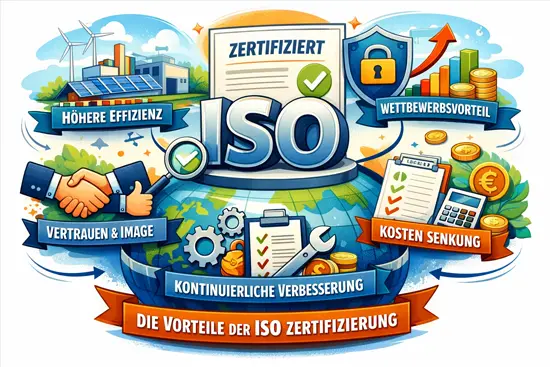
The ISO certification is considered one of the most important quality indicators for companies worldwide. Whether a small business or an international corporation, an ISO certification signals professionalism, efficiency, and trust. But what specific benefits does an ISO certification really bring? In this article, you will learn everything important about the topic.
ISO certification is based on international standards from the International Organization for Standardization (ISO). These standards define requirements for management systems, processes, and company standards.
The most well-known standards include:
- ISO 9001 – Quality Management
- ISO 14001 – Environmental Management
- ISO 27001 – Information Security
- ISO 45001 – Occupational Health and Safety Management
- ...
Certification confirms that a company meets these standards and continuously improves.
The Main Benefits of ISO Certification
1. Higher Quality and More Efficient Processes
Introducing standardized processes sustainably improves the quality of products and services. Companies work more structured, reduce errors, and optimize workflows.
👉 Result: Less waste, lower costs, and better outcomes.
2. Competitive Advantage in the Market
ISO certification gives you a clear edge over competitors. Many customers and business partners now require certified standards as a prerequisite for cooperation.
👉 Result: Particularly important for tenders and bids.
3. Greater Trust from Customers and Partners
A certified company appears professional, reliable, and transparent. Customers know they can rely on consistent quality.
👉 Result: Trust leads to stronger customer relationships and increased revenue over time.
4. International Recognition
ISO standards are valid worldwide. This means:
- Easier market entry into new countries
- Better collaboration with international partners
- Higher credibility in global competition
👉 Result: Ideal for companies planning international expansion.
5. Legal Security and Risk Minimization
ISO standards help ensure compliance with legal requirements and identify risks early.
👉 Benefits: Lower liability risks, better documentation, and structured compliance.
6. Increased Employee Motivation
Clear processes and responsibilities provide guidance in daily work. Employees know exactly what is expected of them.
👉 Leads to: Higher satisfaction, fewer mistakes, and better teamwork.
7. Continuous Improvement (CIP)
A central component of ISO standards is the continuous improvement process.
👉 Result: Companies benefit from regular audits, systematic optimization, and long-term growth.
8. Cost Savings
More efficient processes and fewer errors reduce costs in the long term.
👉 Examples: Less rework, reduced material usage, and optimized resource utilization.
Which Companies Benefit from ISO Certification?
ISO certification is generally worthwhile for companies of all sizes and industries, as it serves as a universally recognized quality proof. Organizations operating in competitive markets or working with demanding customers and partners benefit particularly. Manufacturing companies can increase efficiency and reduce error rates through standardized processes, while service providers profit from clearly defined workflows and improved service quality. IT companies benefit from standards like ISO 27001, demonstrating competence in information security. In healthcare, structured processes are crucial for quality and safety. Construction and industrial companies also gain an advantage, as standardized procedures and documented standards are often prerequisites for tenders. Overall, ISO certification is suitable for all companies that want to optimize internal processes, strengthen their market position, and achieve long-term growth.
Are There Only Benefits or Also Drawbacks?
Despite the numerous benefits, implementing ISO certification involves certain challenges that companies should consider. Initially, significant time and cost are usually required, as existing processes must be analyzed, documented, and often adjusted. For smaller companies, this initial effort can be a hurdle. Certification also requires organizational change, with clear structures, responsibilities, and regular checks to be established. Even after successful certification, effort remains, as regular internal and external audits are necessary to ensure compliance with the standards. Nevertheless, these drawbacks usually diminish over time, as optimized processes, higher efficiency, and improved market opportunities generally outweigh the initial investments.
PeRoBa Quality Management from Munich – Custom Quality Management and ISO Consulting

PeRoBa GmbH Munich
Certification Benefits
Consulting, Implementation, Audits, and QM Tools from a Single Source
PeRoBa GmbH Munich is a service provider with many years of experience in quality management, especially in the automotive and mechanical engineering sectors.
We assist with all key standards (ISO 9001, VDA 6.3, IATF 16949, ...) on the way to certification or recertification.
We show you how to actively counteract ISO certification drawbacks.
We look forward to hearing from you. The best way to reach us is by phone at
+49 8106 / 230 89 92
(additional
contact options)
Quality Management – ISO 9001, VDA 6.3
and IATF 16949 Consulting and Audits – www.peroba.org